At the same time, Jim Cramer is saying the bear market is over.
Now that retail hype is in, it’s time to pull the rug?
At the same time, Jim Cramer is saying the bear market is over.
Now that retail hype is in, it’s time to pull the rug?
I thought the same thing when Cramer said that. UW has an inverse Cramer index for a reason!
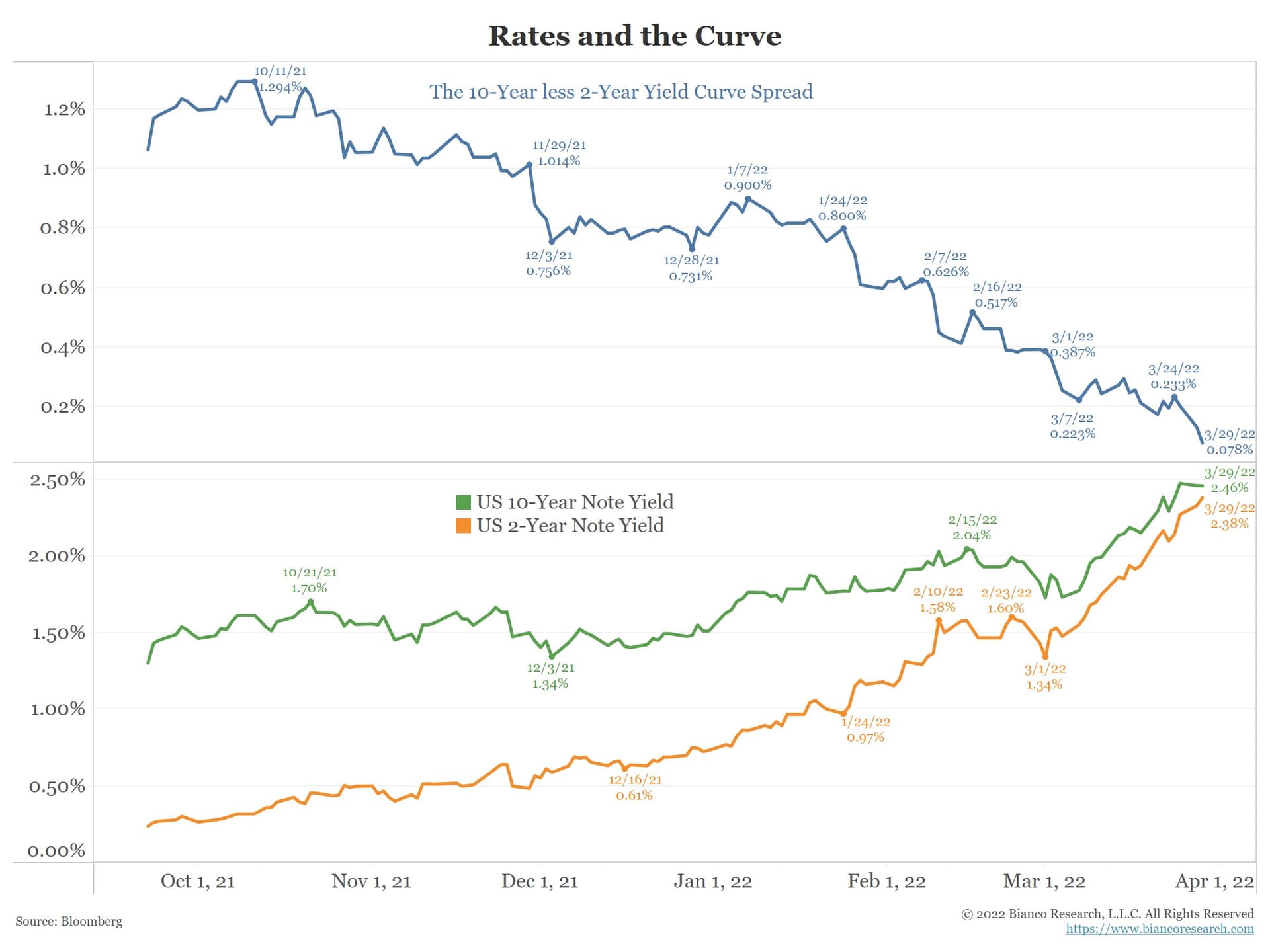
There’s been much said about the inversion of the yield curve, and this one point seems to provide a fairly convincing counter to why it might be a weaker signal of recession than before.
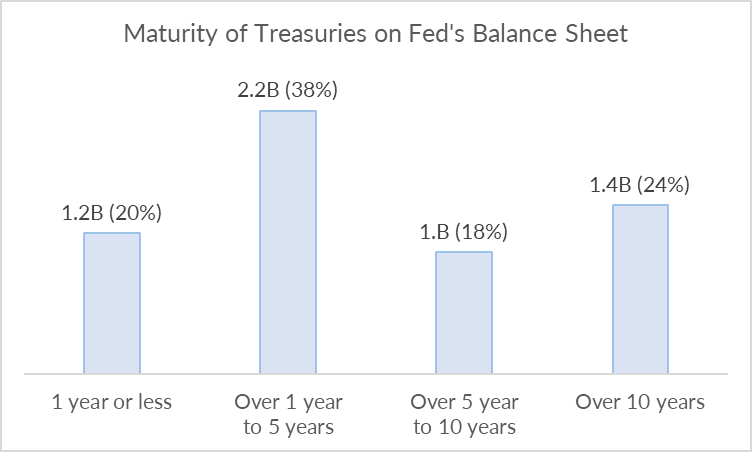
The Fed has distributed maturities of the 5.8B in Treasuries pretty evenly:
(Soured from: Fed’s Stats Release from Mar 24, Page 4)
One of the reasons yields have been low is precisely because the Fed has been purchasing these bonds. Because of the demand the Fed created, yields went lower than if only the usual suspects were purchasing these bonds.
Now that asset purchases will have stopped as of March 2022, we can expect more of a “natural” pricing of T-bonds. Where the yields of all maturities go up as the Fed’s demand disappears, and the yields of longer term ones go up even more to reflect duration risk - as it should be.
And perhaps therein lies the signal - if longer maturity yields do go up more than shorter maturity ones next month, then the current “inversion” would end up being a QE-distortion.
But if the curve remains inverted even with asset purchases done with, then it truly is a reflection of harder times ahead.
Just a consideration to keep in mind as we early wait for the finale of “will she invert? won’t she?”
(Source)
Thank you as usual for your great perspective. Im looking at how the fed has distributed these treasuries and I would love to get your thoughts on this,
58% - Less than 1y to 5y
42% - 5y to 30y
Wouldnt that mean QE has kept shorter maturities yields lower due to increased buying pressure?
And its a big assumption, but assuming the fed does start QT in May, wouldnt that reverse and push shorter maturity yields higher due to increased selling pressure?
I am also looking forward to the season finale of “will she invert” 
Thanks again !
After today im going to take a different approach to this thesis. I have enjoyed exploring the world of macroeconomics and will continue to do so. But it has been challenging to say the least. Ive done okay and fortunately been able to be agile and cut losing positions early, but the opportunity cost has weighed on me.
I will still be playing CPI numbers, FOMC minutes and meetings but my longer term strategy will change to focusing more on trends in tandem with the indicators I have been focusing on. I’ll continue to update this thread with big moves or developments as my conviction remains high, but for now I need to take a step back and allow the market to do its thing. Patience is a superpower Im committed to being better at. As the saying goes- “Be humble or be humbled”
Looking forward to more conversation in the future. Love this community, it really is mind blowing how much knowledge gets shared here and for that Im forever grateful.
Hi, been a while, just popped back in to say 10 years and 2 years inverted today:
https://www.reuters.com/business/finance/us-yield-curve-inversion-what-is-it-telling-us-2022-03-29/
K bye
Wouldnt that mean QE has kept shorter maturities yields lower due to increased buying pressure?
And its a big assumption, but assuming the fed does start QT in May, wouldnt that reverse and push shorter maturity yields higher due to increased selling pressure?
Hmm, interesting question. Given that the Fed is stopping purchases of bonds of all maturities, and the maturities themselves are relatively balanced in distribution, I imagine the effects will be similar across all maturities. And to the extent that QT entails letting the bonds reach maturity and effectively expire, but not actually sell them actively, it should not exacerbate the downward pressure on bonds.
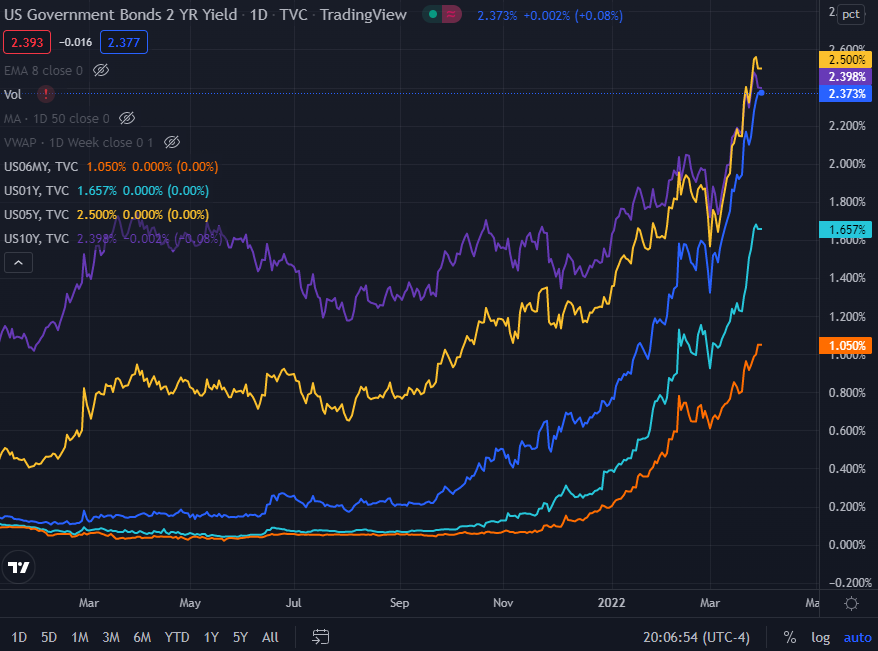
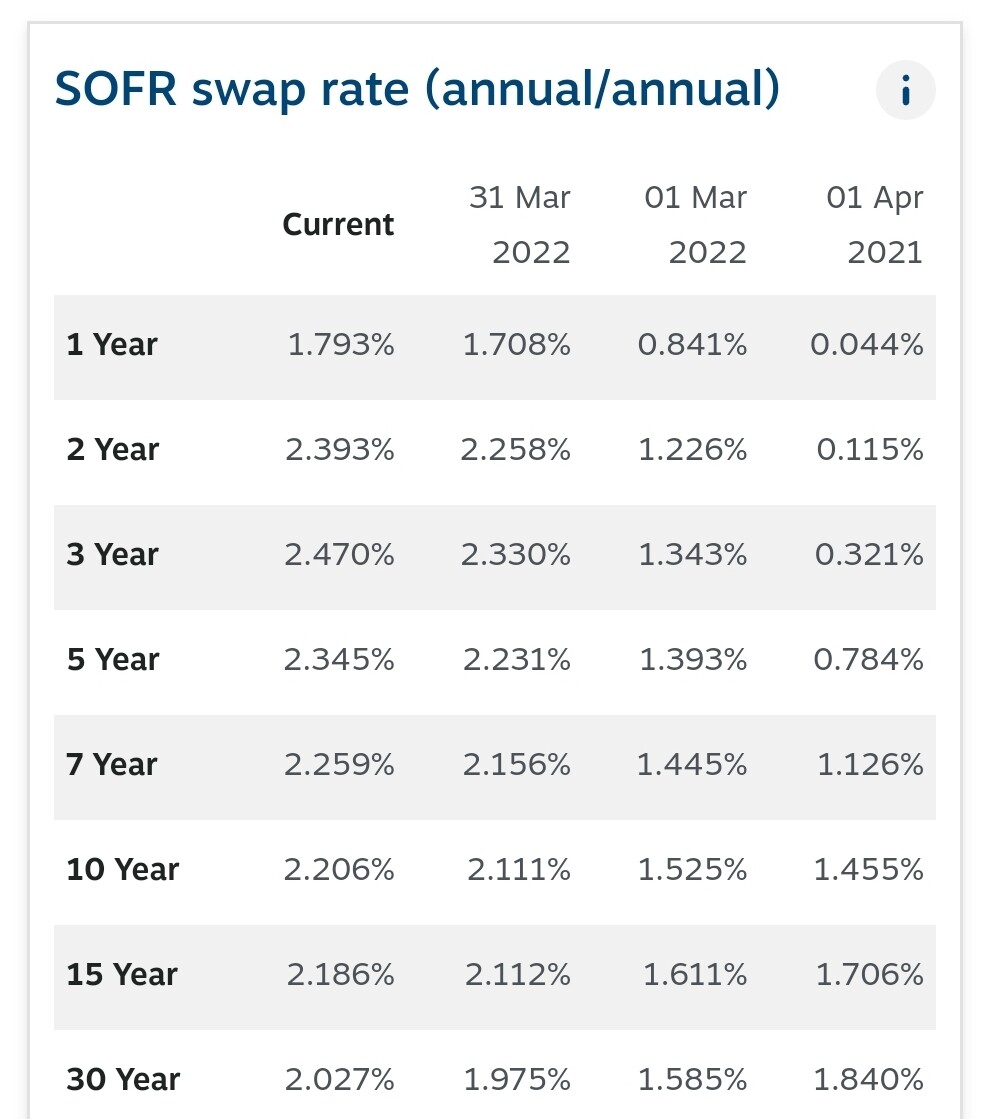
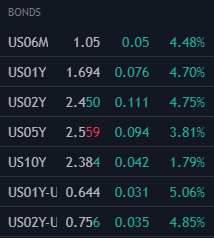
Now, this will have to be paired with the corresponding demand for those bonds, and that really depends on what the market is expecting. For now at least, it is buying that the Fed can stick to their plan - that rates will increase to about 1% in 6 months, 1.7% in a year, and 2.4% in 2 years. To the extent that the long term rates are expected to be 1.x%, it makes sense then that the 5Y is around 2.5%.
Another interesting thing - the response seems to be entirely correlated with the increase in Fed rates, which in turn is mostly driven by inflation concerns. Growth - or lack thereof - is usually another driver of fed rate changes, but the jury is really out on the “recession” thing, and so the bond market doesn’t really seem to be considering this one way or another.
Sure, the inversion of the yield curve has almost always been accompanied by a recession in the recent past, but it doesn’t cause it. The things that were making the curve invert were also causing recession - basically a slowing down of the economy. We are in a very different world now, thanks to all the QE and QT going on, and it is possible that inversion might end up being just a correlation thing. After all, job growth is still there, we’re essentially at full employment, and the recent PMI indices were all positive.
Fascinating times.
Thanks for sharing this, @juangomez053 ! Particularly enjoyed the paper it links to: (Don’t Fear) The Yield Curve, Reprise
For one, it very eloquently expands on a few themes we’ve been discussing in this thread. Just worth a read for the prose.
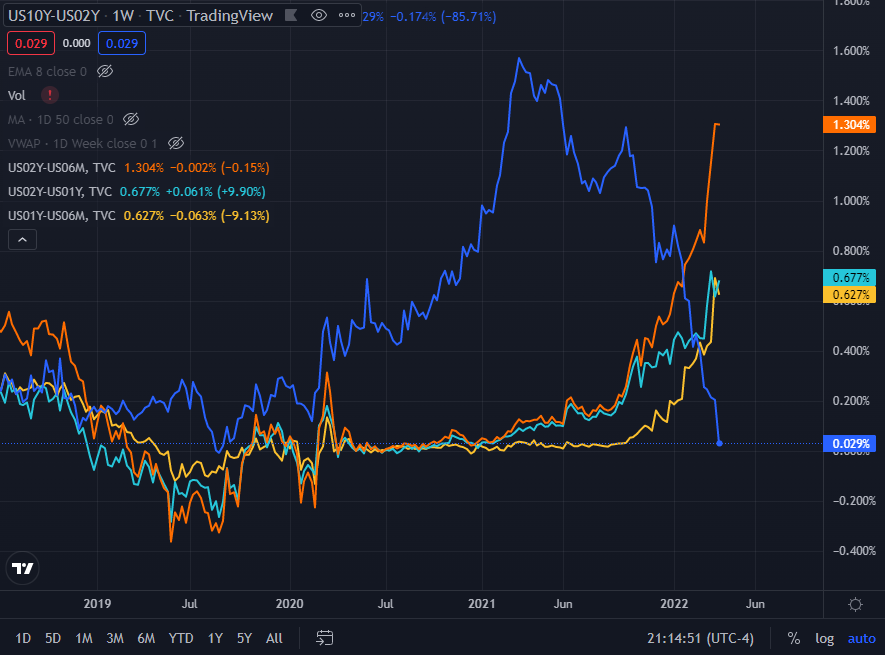
It also makes the case that “near-term forward spread” (based on yields from Treasury bonds with maturities shorter than two years) is a better predictor than the popular 2Y-10Y spread. I don’t know how to replicate that measure in TradingView (it’s 3-month T-bill now vs 3-month T-bill 6 months from now) but hopefully the following is a good proxy:
There certainly is no inversion here between any combination of the 6M, 1Y and 2Y yield spreads.
These spreads do seem to be saying, “what recession?”
One important caveat - these right-way-up near term spreads might still allow for a recession - stagflation in fact - where inflation is so runaway that the Fed raises rates even if growth is halting. A little unlikely not just because there isn’t strong evidence of a weakening economy, but also because the Fed has signaled that it’s appetite for high inflation is much more than its appetite for weakening employment or a flagging economy.
I think duration risk is always there on the longer maturities pre QE, QE, Post QE, QT. So fed buying evenly means selling evenly. If all yields go up in a balanced way, we are still inverted.
But I think the bigger question is, If the labor market is strong and unemployment is low, and we are using that as a strength indicator for our economy, then why is our economy slowing?
I believe the answer is you can have low unemployment but still have weaker damand from everyday americans spending their money due to rising costs of housing, energy, and basic necessities. Remember, inflation started rising in July of 2021. The bond market started signaling problems in December. I think the bond market is pricing in that the fed isnt doing enough to control inflation, and that inflation will continue to squeeze the middle class creating less demand for most of the market. I would agree with that, I think every earnings season will start to become a little more disappointing than the one before well into the future. And equities will eventually have to adjust based on real economic drivers, not solely based on bullshit sentiment like what the ceo tweeted about that day. OR the economy will follow the equities market. meaning google hitting new all time highs will raise the middle classes wages faster than inflation, all while the fed is taking away some of thier buying power via credit.
Interesting times indeed.
Im just happy I have a front row seat when this plays out.
Ill add one more thing, company buy backs this year so far are at a pace we have never seen in history, its like the fiscal policy from covid has transferred from the the everday americans to companies that did quite well because of them. Now its the companies turn to spend the money to keep equities growing, but it stops there. And that is how the greatest transfer of wealth in history takes place. But what stimulates equities next? Is the the bigger concern.
BofA put out a note today and the part of the summary that jumped out was
*The Fed funds rate priced in for Dec-2022 is up from 1.57% (6 hikes) to 2.10% (8 hikes)
So the expected rate right now is a good bit higher than previously expected and some suggest we could even see 9 hikes. I don’t see how a soft landing is possible.
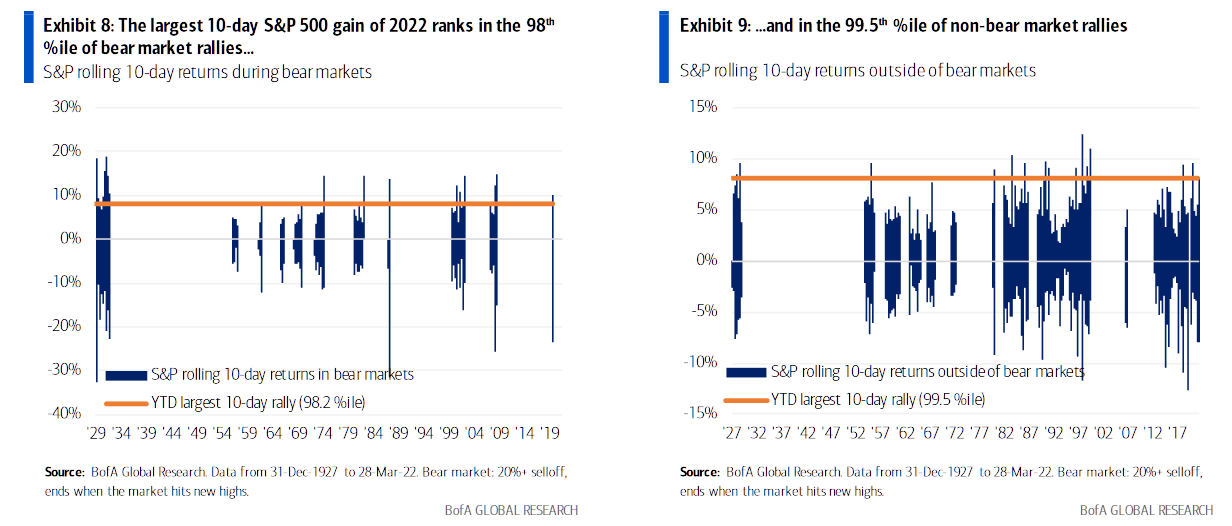
Currently we are seeing a stronger “bear rally” than 7 of the last 9 in SPY and this 10 day run is in the 99.5 percentile of all rallies period.
To put that in raw numbers SPY is 6.7% higher than it was pre-Russian invasion. So with impending rate hikes, record levels of inflation, and a huge rally I don’t see this ending well or in an orderly fashion. Something has to give.
^
Food for thought and best to prepare long run in relation to what BofA found.
Here’s an article stating how there is unprecedented illiquidity in US government bonds, leading to volatility. Some key takeaways for me:
The large selloff in treasuries has occurred before the Fed has begun QT. That could cause further illiquidity in the bond market.
“Primary dealers — the 24 financial institutions that are the traditional market makers in Treasuries — have pulled back from that role since stricter capital requirements were implemented after the 2007-09 financial crisis. Hedge funds and high-frequency trading firms have stepped in to fill the void but often pull back from markets during periods of tumult, a factor that some analysts say heightens volatility.”
Further volatility could tighten financial conditions, making it harder for companies and consumers to obtain financing, “which could slow the economy quite meaningfully.”
https://www.ft.com/content/3494abc9-0b87-4206-8ad3-9e09b5e11730
In response to the article @TheMadBeaker posted on TF today regarding Gary Friedman, the CEO of Restoration Hardware. He gave soft guidance for the rest of 2022, and actually referenced the movie The Big Short on the earnings call to describe his view on the current Macroeconomic conditions. Also mentioning high inflation and low consumer sentiment.
Unsurprisingly, RH dropped 13% today.
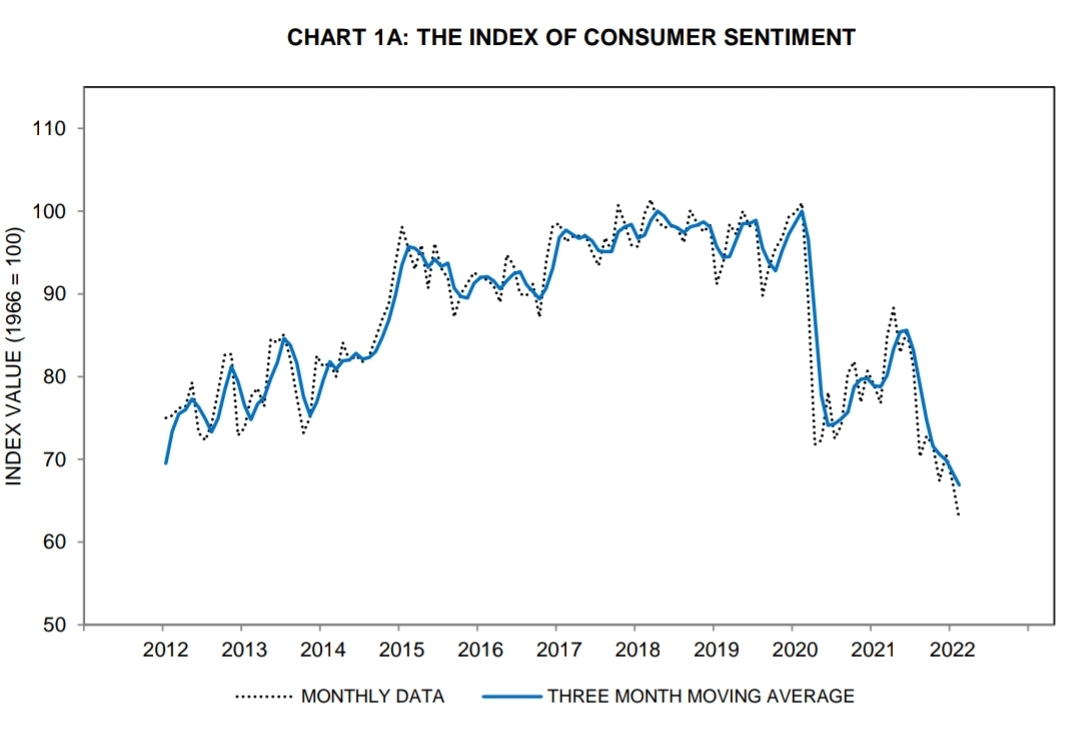
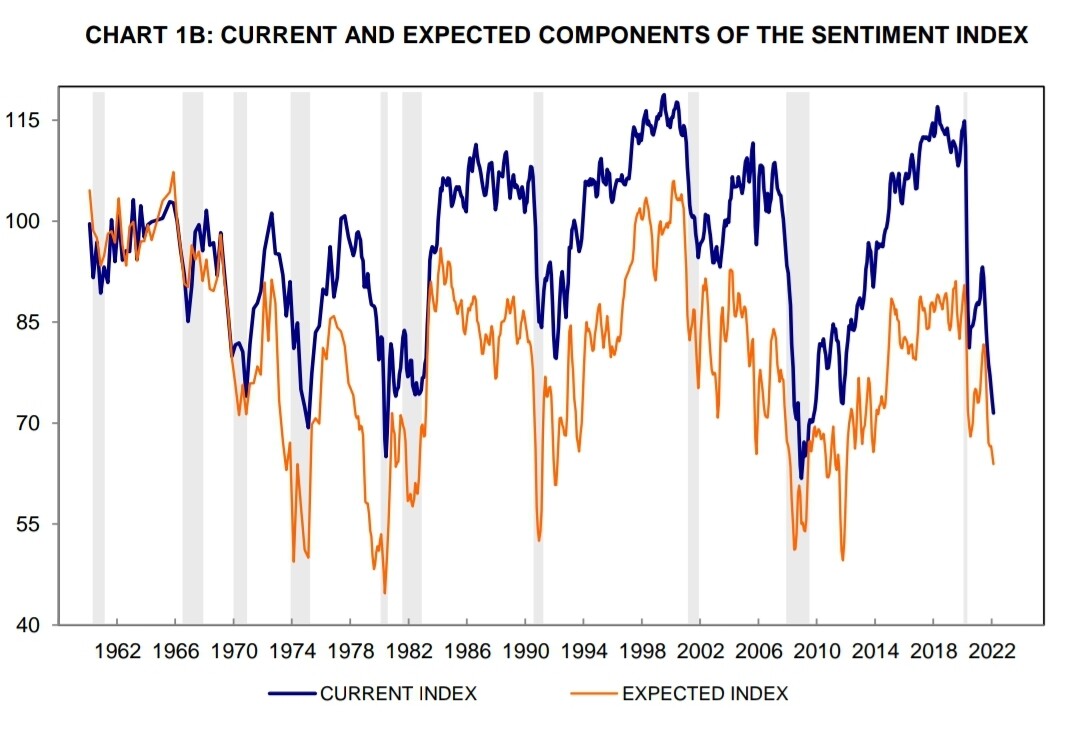
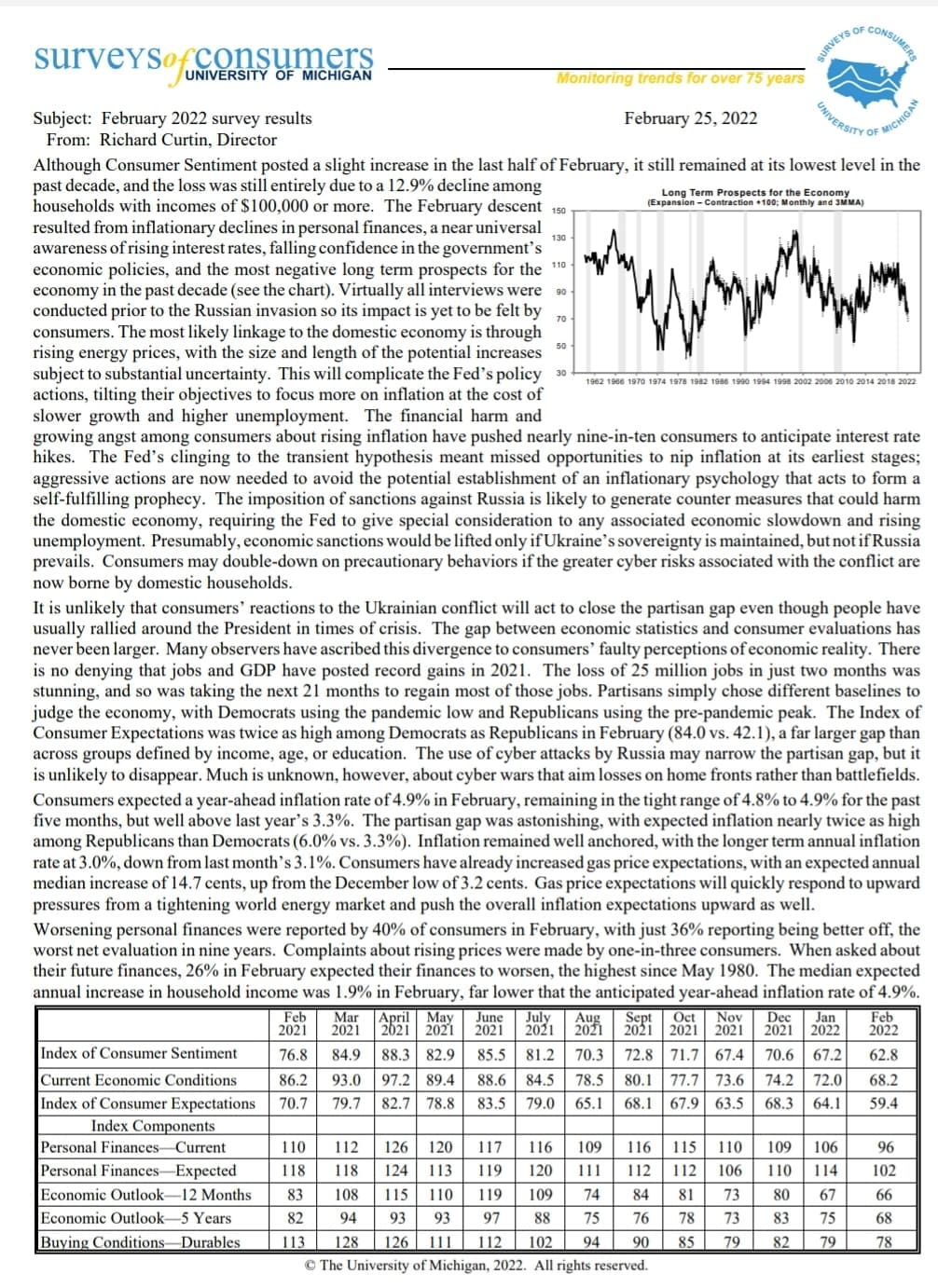
I found some interesting data from the University of Michigan that tracks consumer sentiment. This is unrelated to the stock market, just general economic outlook from everyday households. They have used a 13 page survey every month for 75 years, so there is quite a bit of info here, but here are a few things that stood out as I scratch the surface.
My first thought was “how does their data hold up historically”
Found this chart, recessions are the gray bars.
And their Feb 2022 survey results.
They mention this in the results, but its worth noting that all of the surveys were done pre Russia invation.
Will definitely be watching this survey monthly in the future.
And the article that was posted on TF
https://www.bloomberg.com/news/articles/2022-03-30/everyone-s-talking-about-the-rh-ceo-s-ominous-macro-comments-on-the-company-s-earnings-call?utm_source=google&utm_medium=bd&cmpId=google
With another I found since the first requires a bloomberg subscription.
And also a link to the Survey website if you are interested in the data.
Thanks @TheMadBeaker for the article!
This is such a treasure trove of consumer sentiment information!
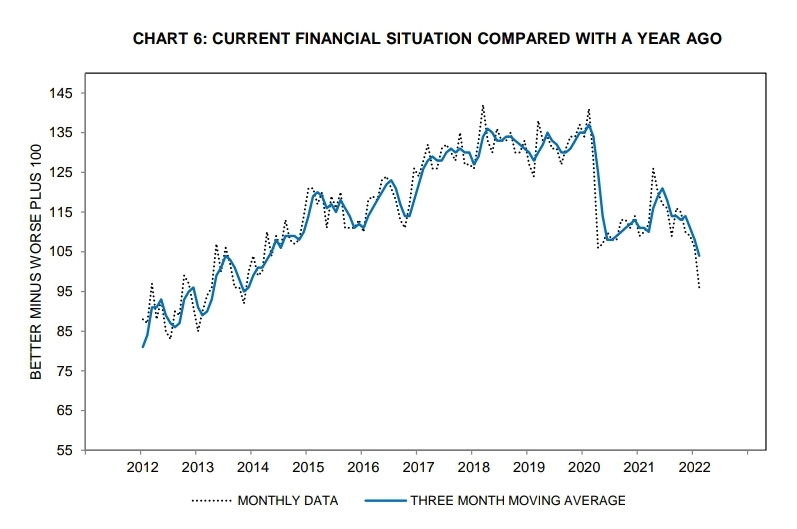
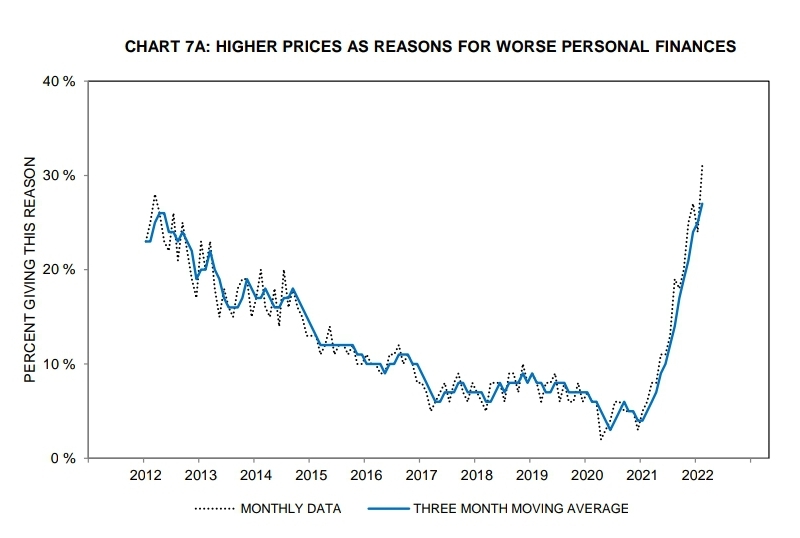
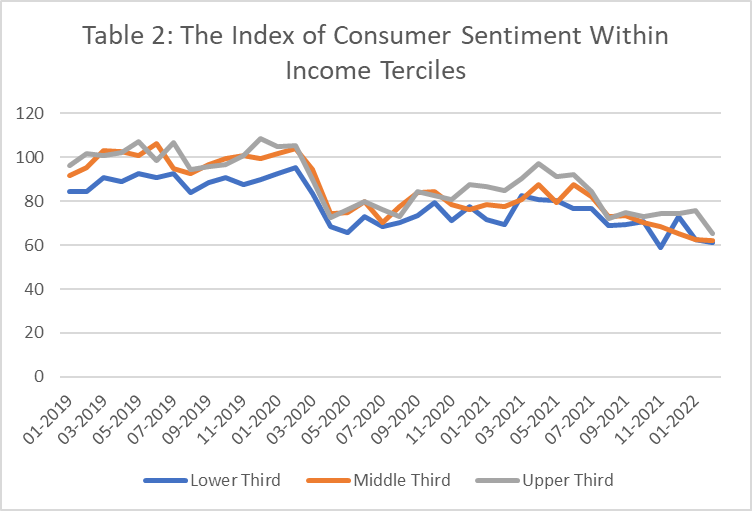
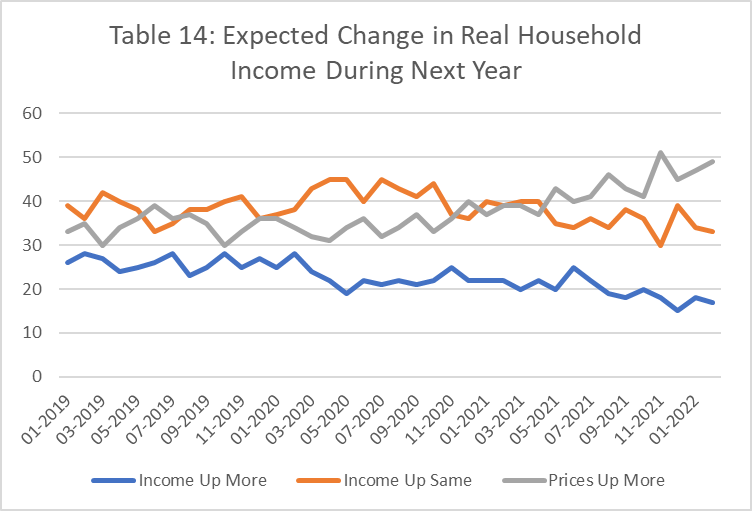
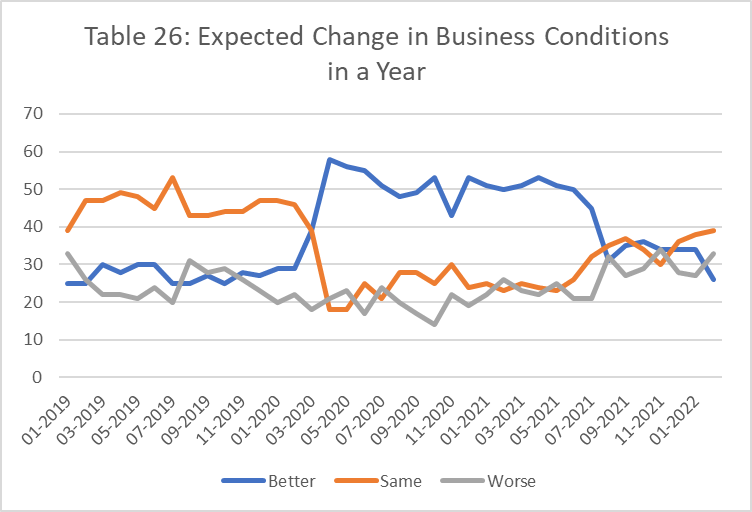
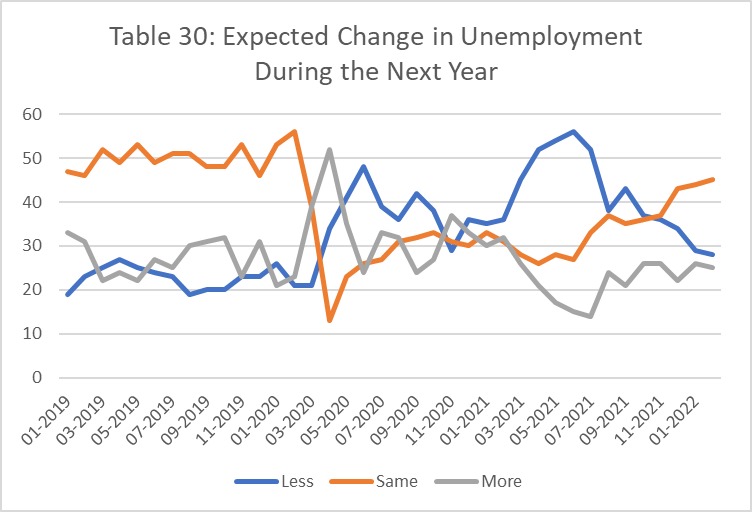
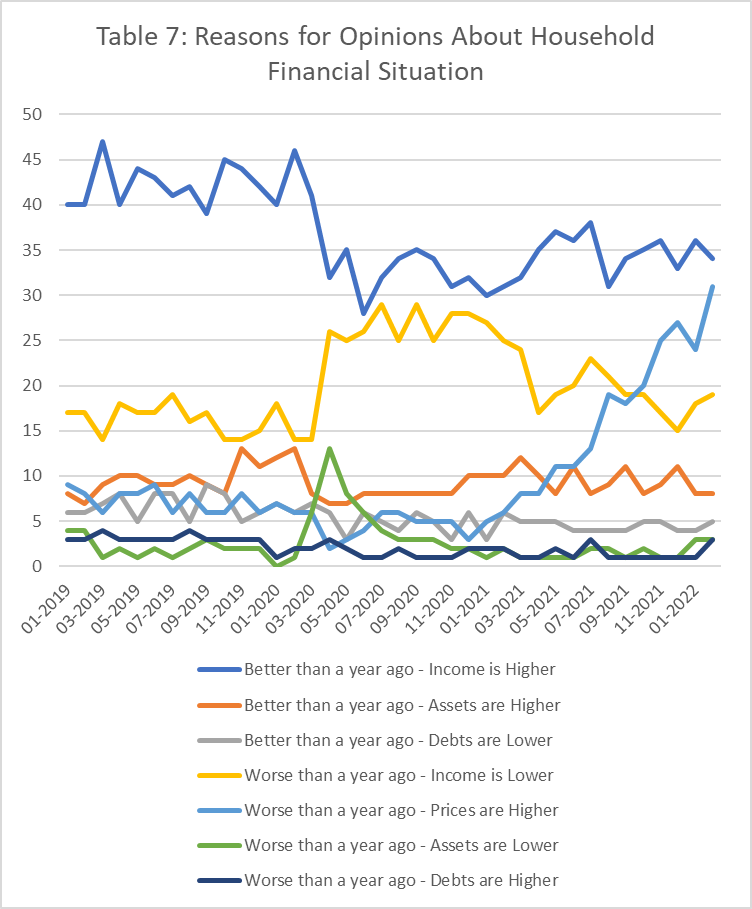
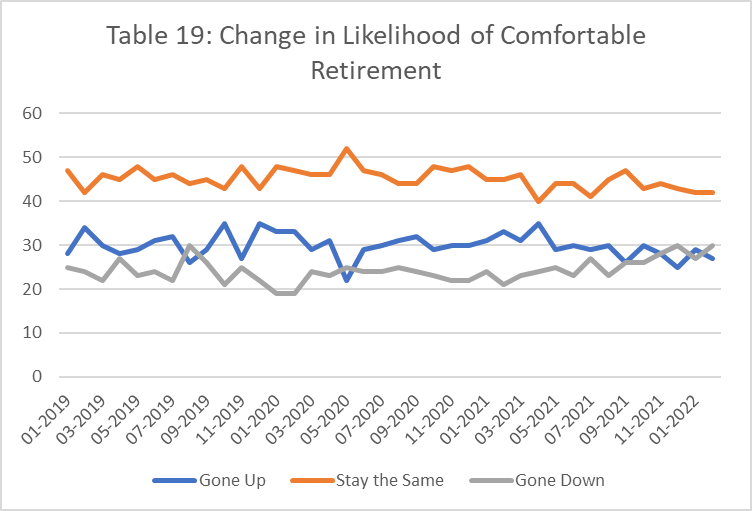
They have kindly shared all kinds of cuts of the data here: Surveys of Consumers - Data. Sharing some of the graphs pulled from the data below.
To the extent that consumer sentiment significantly impacts aggregate demand, this does portray a rather worrying picture.
Summary:
Significantly more expect prices to run away from their purchasing power (Table 14). No surprise, as inflation prints tell us the same. However, this does mean people will spend less, thereby reducing aggregate demand. Will be interesting to see if consumers were actually leading inflation prints in this regard.
More respondents expected business conditions to be Worse in a year vs Better in Feb, a flip that happened this month, though it is a three way split. This may mean that people invest less in business and take fewer risks because they expect headwinds. (The big bump of Better in the middle is because of COVID - we expect to come out “better” compared to lockdowns.) (Table 26)
Increasing prices are the clear driver for folks feeling their finances are worse than a year ago. Has switched places with “Income is Lower” as a reason for worsening financial situation. Interestingly, the proportion of “Better than a year ago” hasn’t really gone down. (Table 7)
Slight increase in folks who think the chances of a comfortable retirement has Gone Down, vs Gone Up. (Table 19) If this starts to trend downward strongly, then we are in real trouble, as a change for a much dimmer view of retirement would imply that folks think we’re stuck with economic hardship for a long time.
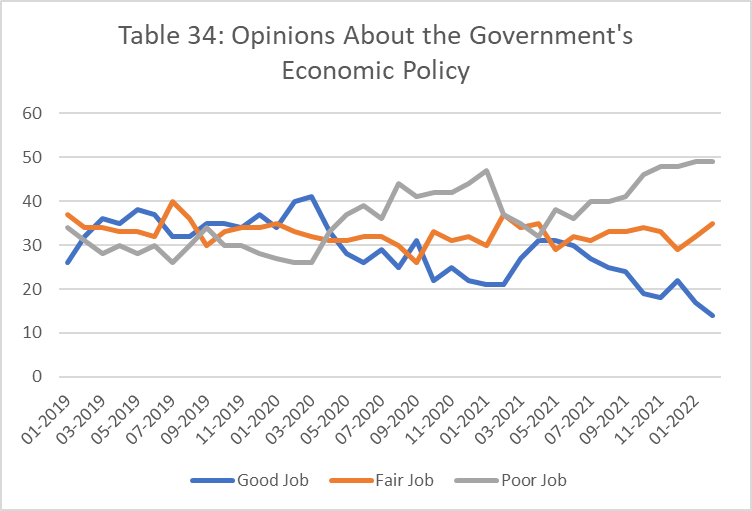
It is very clear that there is little faith in the government’s ability to do a good job with the economy. To the extent that the govt has played a significant tole in managing economic hardship during Covid times, this is a rather damning indictment. If people feel folks in power do not have their backs, they will hunker down. (Table 34.)
New video by Dave Lee on the yield curve inversion: https://www.youtube.com/watch?v=ZcKwRA2JuHo
Notes as I go:
Yield curve inversion means bond investors expect economic contraction, lower demand for short-term bonds and thus increasing yield.
Flat/inverted yield curve could deter lending by banks because if long-term yield is the same or less than short-term yield, then they may not want to lend as much.
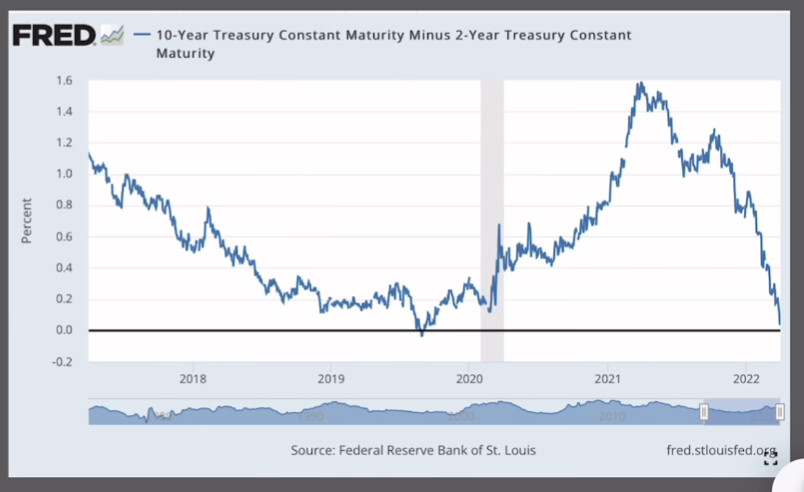
Inverted yield curve has preceded the past 6 recessions in around 40 years, in both the 10 yr vs 2 yr as well as the 10 yr vs 3 mo.
The 10/2 yield curve inverted briefly on Tuesday and Thursday for the first time since September 2019.
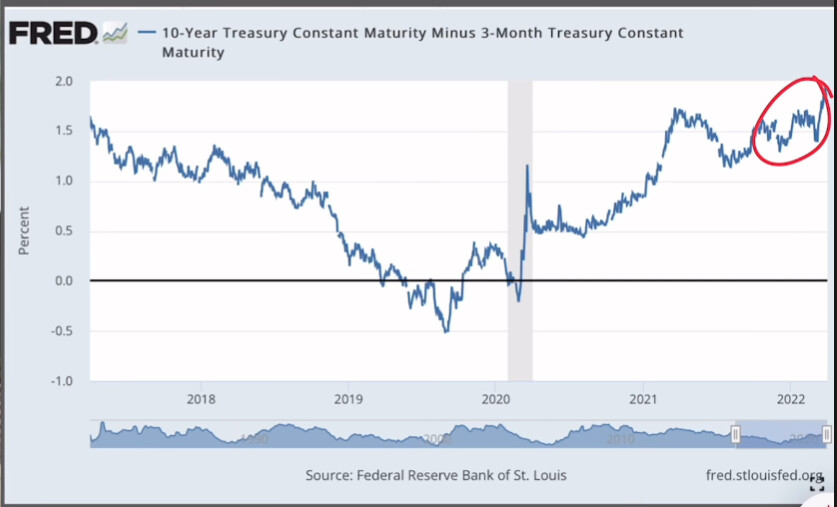
10 yr / 3 month is not even close to inverting. Pretty significant and healthy spread there.
Arturo Estrella & Frederic Mishkin estimates a 5% probability of recession based on the 10 yr / 3 mo spread, but a 25% probability based on the 10 yr / 2 yr spread.
For recession risk to rise substantially more, we need to watch for: 3 month yield to rise above 10 year yield, and also for yield curves staying inverted for longer periods of time, i.e. for an entire calendar quarter, not just a couple of days.
Average time from inversion to recession has been 16 months, ranging from 6 to 24 months.
In periods of recession, be in companies with high free cash flow generation, solid balance sheets, and able to withstand periods of economic weakness. Also pricing power, high growth rates.
Historically we have seen that stock market has room to run and peak approx 12 months after yield curve inversion, before the actual recession.
My key takeaway is the bolded note above. The current inversion activity is not yet a significant indication of recession.
For recession risk to rise substantially more, we need to watch for: 3 month yield to rise above 10 year yield, and also for yield curves staying inverted for longer periods of time, i.e. for an entire calendar quarter, not just a couple of days.
Port update.
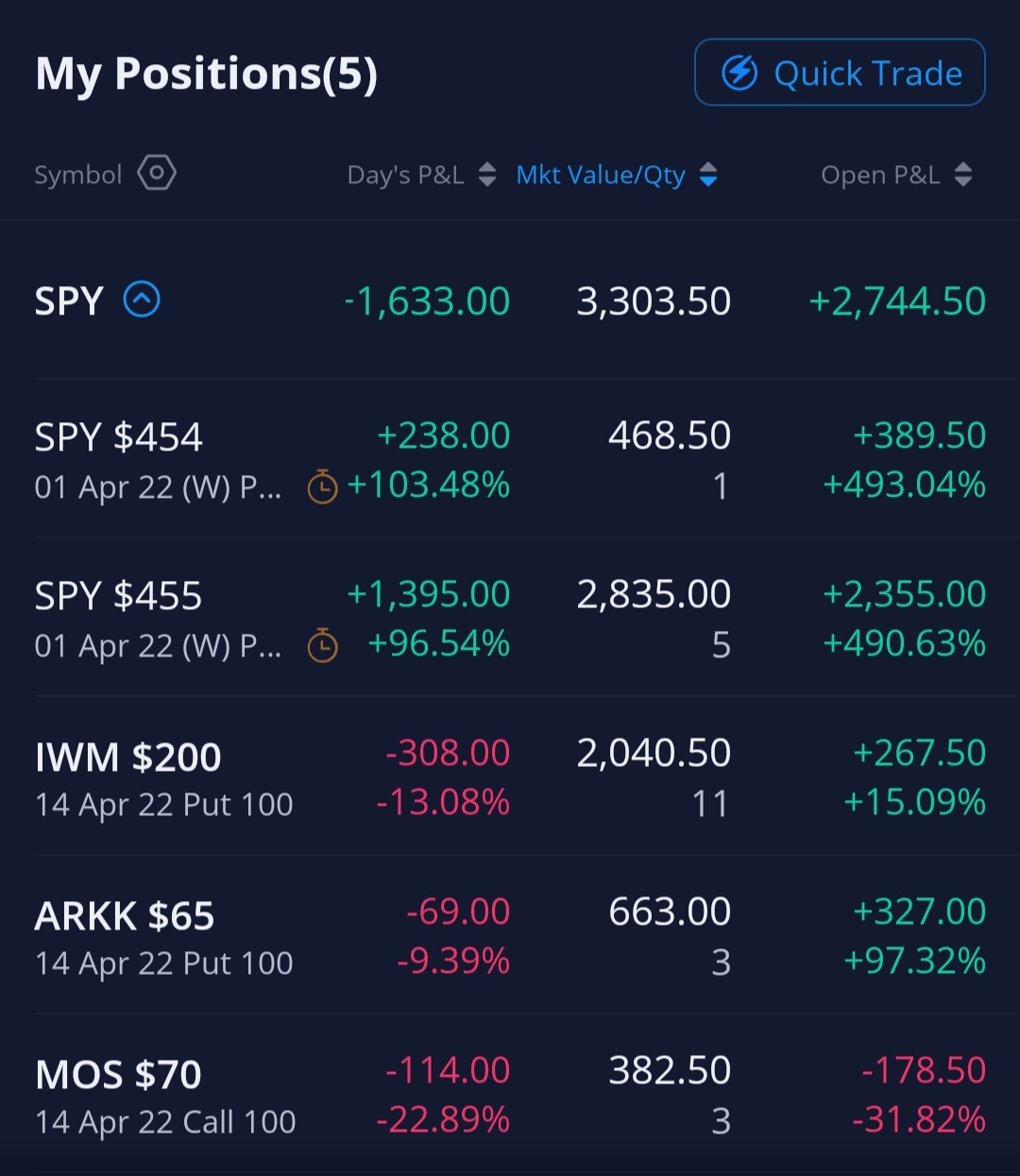
Playing smaller movements for now, tighter OTM. Cut these SPY puts when it tested 429.30ish the second time today. Bought them yesterday morning when the market went green. Cut cost early, cut multiple rounds of profit, using a loose SL after that. Holding whats left of my IWM, ARKK puts and MOS calls into next week.
Will prob not be active here for the foreseeable future. Got news my father passed away late last night and Im in a bit of a fog, and feeling quite sensitive to the grieving process.
All i want to say is, hold your family close, reach out often, even just to bs. Communicate exactly how you feel and ask all the questions you could ever think of. Thier parents, childhood, how they see the world, life advice, etc. Someday you will be glad you did.
Hope everyone makes a killing while im away, looking forward to seeing everyones positive port updates. Dont forget to pay attention to CPI numbers and FOMC minutes coming soon. Play them if it looks good, but at the very least respect thier significance and be cautious.
I am so sorry to hear about the passing of your father. Take the time to grieve, remember him, and heal. Everything else can wait.
With unemployment print at 3.6% today - 0.1% away from a 50-year low that would also tie to pre-pandemic numbers - no reason for Fed to not be as hawkish as needed. Market is reacting to it with the 6mo going over 1%, the 1y pulling away from the 6mo, and the 2y pulling away from the 1y.
Now, the 10Y-2Y has also flipped today as a result, as the 10Y did not share the enthusiasm, so “recession is coming” is still the mantra of the day. Market really doesn’t feel like it’s happening in the next 2 years though.
I’m really sorry about your loss, straight up just called my dad because of your post. Take care of your self.